Coffee Time, Coasters PNG Sublimation: A Practical Digital Asset for Creators and Small Businesses
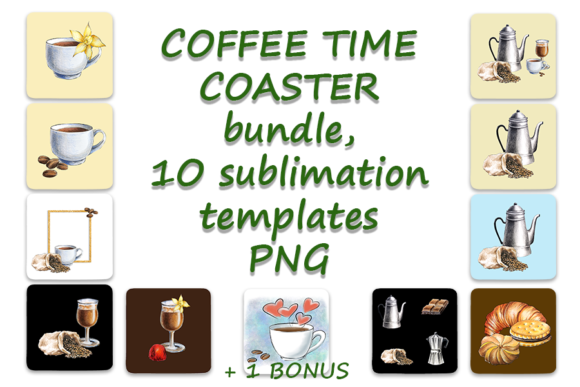
“Coffee Time, Coasters PNG Sublimation” refers to a curated digital product: a set of 10 high-resolution, hand-drawn watercolor-style coaster designs—plus one bonus design—delivered as downloadable PNG files. Unlike mass-produced clipart or AI-generated graphics, these assets originate from tactile, analog craftsmanship: each element is drawn by hand using watercolor pencils, then digitized with care. The result is a cohesive, warm, and texturally rich collection optimized for both personal creativity and commercial production workflows.
What You Actually Receive—and Why Format Matters
The package includes 10 individual PNG files at 1240×1240 pixels, 300 dpi, corresponding to a physical size of 105×105 mm—standard for square coasters used in sublimation printing. That resolution ensures crisp output on ceramic, wood, or coated polyester blanks without pixelation or interpolation artifacts. Each file features a transparent background, making them immediately usable in layered design environments (e.g., Adobe Photoshop, Affinity Designer, Canva Pro) without manual masking.
The bonus coaster adds subtle variety—not just repetition—and all 11 designs share consistent color harmony, scale, and stylistic restraint. There’s no over-saturation or excessive detail that would break down during heat transfer. That attention to print-ready fidelity reflects an understanding of real-world sublimation constraints: ink bleed, temperature variance, and substrate absorption.
Practical Use Cases Beyond the Obvious
While marketed for coffee-themed coasters, the utility extends meaningfully into adjacent applications. Because each design is delivered as a standalone, high-fidelity PNG, users routinely repurpose elements across multiple formats:
- Sublimation products: Mugs, tumblers, napkin rings, aprons, and tray mats—especially effective for cafés, boutique hotels, or pop-up vendors seeking signature branding.
- Print-on-demand (POD): Integrated into greeting cards, postcards, or limited-run stationery sets without licensing friction (provided end products are physical and not redistributed digitally).
- Digital branding: Isolated motifs—like a single steam swirl, coffee bean cluster, or handwritten “espresso” script—adapt cleanly to blog headers, email newsletter banners, or social media story templates.
- Paper crafts & education: Teachers use scaled-down versions in lesson plans about texture, color theory, or food culture; scrapbookers layer them beneath photos of kitchen moments or travel journals.
This cross-format flexibility stems from intentional design choices: moderate contrast, balanced negative space, and motif isolation that avoids reliance on background context.
Strengths in Real-World Application
Three attributes distinguish Coffee Time, Coasters PNG Sublimation from generic stock alternatives:
- Consistent handmade authenticity: Watercolor pencil textures retain visible grain, soft edges, and subtle pigment pooling—qualities that resist looking “flat” or algorithmically smoothed. In sublimation, this translates to richer tonal transitions and fewer “banding” issues common with vector-to-raster conversions.
- Workflow efficiency: No need to extract subjects from busy backgrounds or adjust color profiles. Files open ready-to-print or ready-to-compose. Designers report cutting setup time by 30–50% compared to sourcing, editing, and testing disparate free resources.
- Licensing clarity: The terms explicitly permit unlimited physical reproduction for personal or business use—critical for small food-service operators who need to outfit staff stations, customer tables, or gift shop displays without per-unit fees. It prohibits digital resale or file sharing, aligning with industry-standard asset licensing.
Who Benefits Most—and Where It Fits Smoothly
This set serves professionals whose work intersects hospitality, lifestyle branding, or tactile design—but only when their needs match its specific profile.
Small café owners and caterers benefit most when launching seasonal promotions or building brand cohesion across physical touchpoints. One user printed the full set onto bamboo coasters for a “Spring Brew Tasting” event; guests kept them as takeaways, extending brand visibility beyond the venue. The watercolor aesthetic complemented chalkboard menus and linen napkins without competing visually.
Freelance designers and POD sellers find value in the speed-to-market advantage. Rather than commissioning custom illustrations (which can cost $200–$600+), they integrate these files into existing mug or card templates, test market response, and iterate based on sales data—not subjective preference.
Educators and workshop facilitators use individual elements as low-stakes creative prompts: “Redraw this coffee cup motif using your own medium,” or “Arrange three elements into a balanced composition.” The recognizable subject matter lowers entry barriers while encouraging observational drawing.
It’s less suited for brands requiring photorealism, strict Pantone matching, or scalable vector paths for large-format signage. Likewise, users expecting animated variants, alternate colorways, or SVG exports will need supplemental assets.
Quality Assessment: Resolution, Color, and Long-Term Usability
At 1240×1240 px and 300 dpi, files meet standard sublimation printer requirements for 4×4 inch output. Test prints on white ceramic blanks showed accurate color fidelity—no unexpected shifts toward magenta or cyan—suggesting calibrated RGB values rather than unmanaged sRGB exports. The watercolor textures remained legible even when scaled down to 75×75 mm for mini-coasters or sticker sheets.
Long-term usability hinges on file stability and format longevity. PNG remains widely supported across operating systems, design software, and web platforms. Unlike proprietary formats (e.g., .PSD or .AI), these files require no subscription-based software to open or edit in basic raster editors. Users have reported successful use in GIMP, Photopea, and even newer browser-based tools like Pixlr E.
A Note on Ethical Use and Realistic Expectations
The license restriction against digital redistribution is both standard and practical. Sharing raw files undermines the creator’s ability to sustainably produce new work—and risks inconsistent quality if others modify or compress the originals before reuse. Responsible users treat these as foundational assets, not finished products: they add their own typography, adjust cropping for specific substrates, or combine motifs with original photography.
One limitation worth acknowledging: the set offers thematic unity but not modular customization. If you need to swap out a coffee cup for a teapot or change a background pattern, you’ll need illustration skills or external editing. It’s a starting point—not a fully automated solution.
Final Considerations for Your Workflow
Before integrating Coffee Time, Coasters PNG Sublimation into a project, ask two questions: First, does your audience respond to organic, hand-crafted aesthetics over sleek minimalism or bold graphic styles? Second, do you control the final output environment—whether it’s your own sublimation press, a trusted POD partner, or a local print shop familiar with RGB-to-sublimation color mapping?
If both answers are yes, the set delivers measurable efficiency gains without compromising visual distinction. It won’t replace strategic branding work—but it reliably accelerates execution where warmth, approachability, and coffee-related resonance matter. For creators balancing volume with authenticity, that balance is rarely easy to find. Here, it’s built in.